
How to find your big idea for the TEDx stage
It’s the first and most important question on our TEDxPortsmouth application: What’s your big idea? You’d think someone applying to speak at a TEDx event would know how to articulate their big idea, but most don’t. Here’s what we tell our speakers at TEDxPortsmouth:
A big idea is not something you’ve heard a million times (or even a few times).
A big idea is not your favorite quote.
A big idea is not a pitch for a product or service.
A big idea is not half-baked or something you “just thought of.”
A big idea is not fuzzy or confusing.
A big idea can be conveyed in under 30 words.
Like a logline to a movie, an elevator pitch to an investor meeting, or a thesis statement to a five-paragraph essay, the BIG IDEA is to a TED Talk. This focus on the "big idea" is central to TED’s identity.
The best ideas are unexpected, provocative, defy expectations, and spark curiosity. Let’s look at a few examples:
Talk: "Do Schools Kill Creativity?" Speaker: Sir Ken Robinson Big Idea: The modern classroom stifles creativity.
Talk: "Your Body Language May Shape Who You Are" Speaker: Amy Cuddy Big Idea: Adopting powerful body language (e.g., "power poses") can positively impact performance.
Talk: "Why I Gave My Teenage Daughter a Vibrator—and You Should Too" Speaker: Robin Buckley Big Idea: If you want your teenage daughter to grow up to be a confident woman, give her a vibrator.
Finding YOUR Big Idea
From my experience as a producer, nothing—not even memorizing—is harder than coming up with the big idea.
Part of why it’s so hard for applicants to articulate is that they haven’t done the necessary work to figure out what can be their big idea.
Before you can come up with a pithy idea, you need to first figure out what you’re qualified to talk about. When evaluating applications, we check three boxes:
You are an expert in the “big idea” you wish to share. Many applicants are amateur enthusiasts. For example:
You are the right person to share this big idea.
It’s the right time for you.
Example: A speaker once pitched a talk about using technology to get teens excited about volunteering. It was an intriguing concept, but they were still in the early stages of testing their platform and lacked the data or experience to back it up.
Your Talk Must Appeal to the Audience—Both Locally and Globally
TED Talks are meant for general interest. Ask yourself:
Will this be interesting to an intelligent, average audience, or just to experts in your field?
Does your talk address universal themes like love, loneliness, loss, discovery, or creativity?
TED Talks live two lives: one for the live audience and one as a YouTube video. While it’s fine to reference a specific place, your talk needs universal appeal. For example:
NO: “How to Make Portsmouth Better”
YES: “How to Make Small Cities Better”
Finally, TED’s mission is to inspire action. Ask yourself:
What do you want the audience to do as a result of hearing your talk?Use less single-use plastic?Treat the elderly with more compassion?Design a more inclusive community?Listen better?
If you can’t answer this, you don’t have your big idea yet.
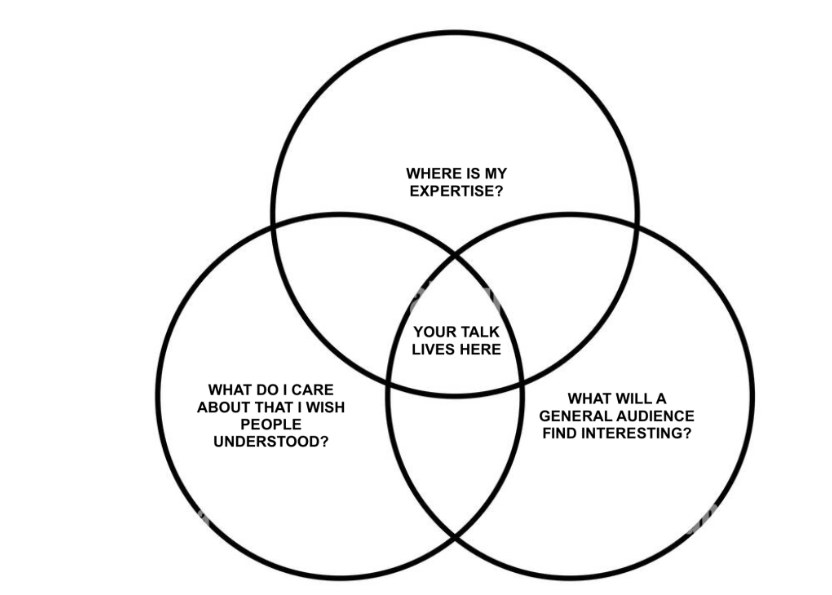
Visualizing Your Big Idea
Many speakers say they’ve been thinking about their big idea for years, while others know they have something important to say but aren’t quite sure what it is. Let’s visualize this challenge:
Picture a Venn Diagram:
One circle is what you’re interested in—something you love to talk about and share.
The second circle is what you have expertise in—usually either a deep personal connection, a degree, or both.
The third circle is a topic that has value to the audience and inspires action.
Your talk lies at the intersection of these three circles.
Choosing Between Multiple Big Ideas
If you’re qualified to talk about more than one topic, congratulations! Lots of people give multiple TED Talks, but for this event, you need to pick one.
Here’s how to narrow it down:
Make a list of all your potential big ideas.
Cross off any where you lack genuine expertise.
Consider the time investment: If you’re not wildly passionate about a topic, it will get old fast, and your talk (and mental health) may suffer.
Still stuck? Ask for feedback from a range of people—not just family or colleagues. If most people gravitate toward one idea, that’s your winner.
