
7 tricks: How TEDx speakers learn their talks
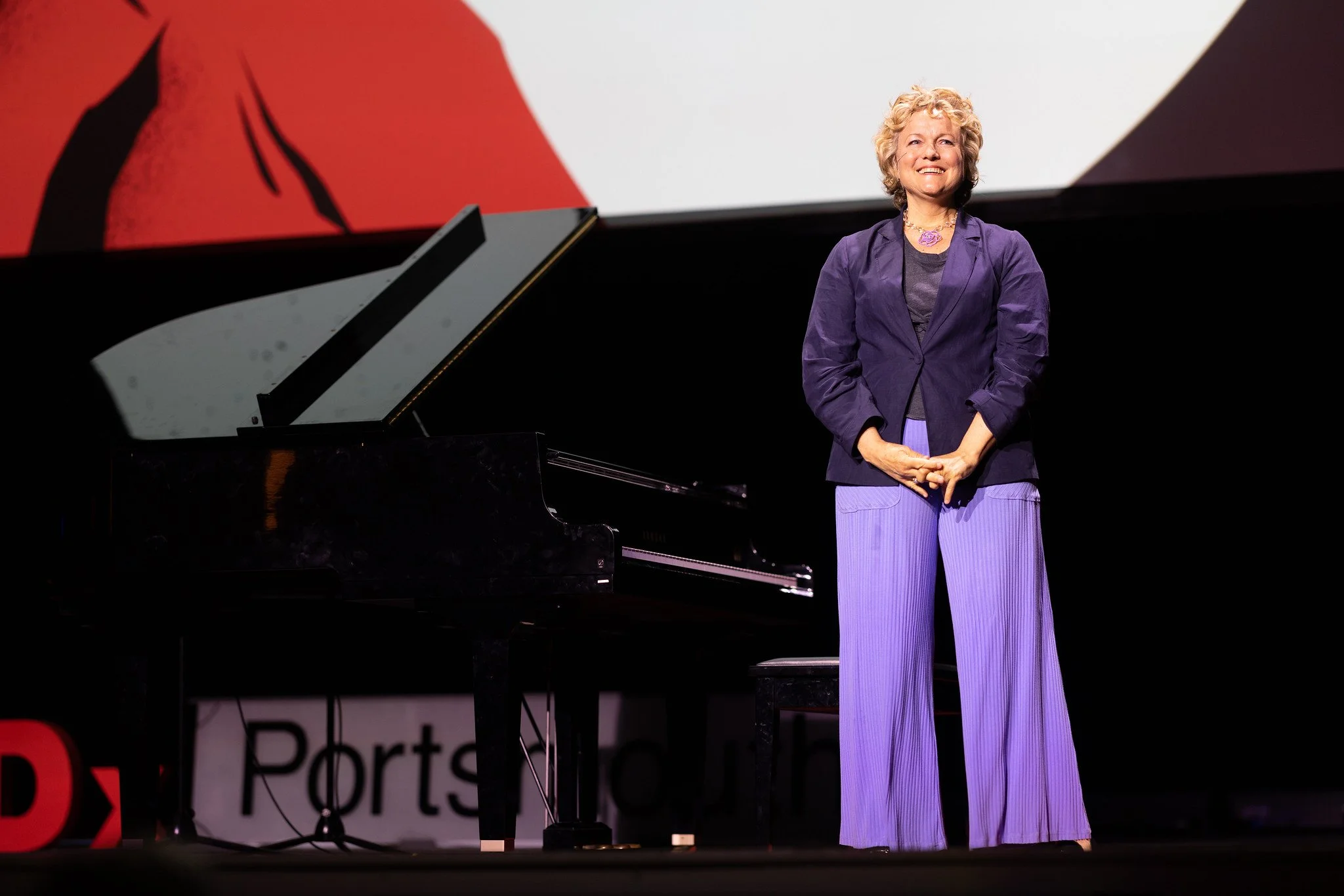
Here's the most useful thing anyone ever told me about giving a talk that I now share with my TEDx speakers: you don't need to memorize it, you need to learn it. (Big thank you to our TEDxPortsmouth performance coach, Melissa Christenson for that!)
Here's what I mean:
Think about how you'd tell a friend the story of how you met your spouse. You'd hit the same beats in the same order every time — but the exact words would shift a little depending on the day, the audience, your mood. That's what you're going for. A talk you've truly learned sounds like a story you're telling, not a script you're reciting.
Now — some people genuinely prefer to memorize word-for-word, and if that works for you, go for it. The thing to know is that memorized talks have one specific failure mode: if something unexpected happens — someone drops a water bottle and you can hear it rolling across the floor, a phone goes off, a baby cries — you can lose your place and freeze. Folks with theater backgrounds or a lot of stage time know how to recover from that. For everyone else, learning the talk (vs. memorizing it) gives you a much softer landing when the unexpected happens, because you always know what comes next even if the exact words wobble.
So with that as the goal, here are some tips for getting there:
#1 Read it right before you fall asleep
This is my favorite one and I'll die on this hill. Keep your script by your bed and read through it right before you turn off the light. Something about that drowsy pre-sleep state lets it just seep in — your brain consolidates it overnight in a way that an extra rehearsal during the day can't touch. It's the single most effective time to do it.
#2 Record yourself and live with it
Voice memo your talk and play it in the car, at the gym, while you're unloading the dishwasher. One caveat from Jessica Bolker, who passed along several of these tips: listening on repeat back-to-back can actually scramble the order in your head. Spaced out across the day is better than marathon.
#3 Think of your talk as an x-ray
Where are the load-bearing bones? If you can hold onto the skeleton, the rest hangs off it. You don't need to know every sentence — you need to know the structure cold and trust yourself to fill in around it.
#4 Use your primate brain
We're evolutionarily wired for images, so lean into that. Sketch a concept map, draw a little rebus, doodle the arc of your talk on a napkin. Jessica did a quick rebus one morning for a set of transitions she kept blanking on, and it unstuck her faster than another five run-throughs would have.
#5 Let your gestures do double duty
They're not just for the audience — they're mnemonics for you. Jessica has a moment where she says "drives science" then "shifts," and she does a subtle steering wheel into a gearshift. Two physical cues, one easy combo to remember. Find the gestures that already feel natural and let them anchor the moments where you tend to slip.
#6 Run it in different accents
Your brain tunes out when it hears the same thing in the same voice over and over — think Ben Stein going "Bueller… Bueller…" until the whole class is comatose. Run your talk in a British accent, then a Southern drawl, then a pirate, then your worst Schwarzenegger. It forces your brain to stay engaged with the actual words instead of going on autopilot, and as a bonus it's hilarious and takes the pressure way down. Just do it quietly in the shower or in your car.
#7 Simulate that nervous feeling
Stage adrenaline is real, and if you've only ever practiced calm and seated, your body won't know what to do with the heart rate spike when you're up there. Get your heart rate up while you rehearse — one speaker I know runs her talk out loud on the treadmill with loud music blasting. Sounds intense, and that's the point. When you can deliver it gasping and distracted, the actual stage feels easy.
And when in doubt, just take a deep breath, then burst into tears in run off the stage. You'll get 'em next year, Tiger.
